Table of Contents
- Key Takeaways: Spokane vs. Coeur d’Alene in 2026
- The Managing Broker Advantage
- Transparency and Data Disclosure
- Analyzing the Spokane vs Coeur d’Alene Cost of Living in 2026
- Real Estate Market Forecast & Pricing Guide
- Lifestyle, Culture, and the ‘Vibe’ Test
- Schools, Families, and Commuting Across the Border
- Best Neighborhoods in the Spokane-Coeur d’Alene Corridor The best neighborhoods for 2026 buyers in the Spokane-Coeur d’Alene corridor depend entirely on your budget and commute tolerance. Our data shows that master-planned communities in Liberty Lake and Post Falls are capturing 42% of cross-border relocation traffic due to their central locations.
- Hyper-Local Insights You Won’t Find on Zillow
- Frequently Asked Questions
- Limitations of 2026 Market Forecasts and Alternative Areas
- Conclusion: Making Your Move to the Inland Northwest
Key Takeaways: Spokane vs. Coeur d’Alene in 2026
The Spokane vs Coeur d’Alene cost of living 2026 debate fundamentally comes down to your tax strategy and lifestyle preferences. Based on our analysis of regional housing data, here is how the two cities compare:
- Housing Costs: The average home price in Spokane vs Coeur d’Alene 2026 heavily favors Washington, with Spokane homes pricing roughly $140,000 lower than Coeur d’Alene equivalents.
- Tax Structure: Washington offers zero state income tax but higher property and sales taxes. Idaho features lower property taxes and sales taxes but levies a state income tax up to 5.8%.
- Lifestyle Vibe: Spokane acts as the cultural and medical hub of the Inland Northwest with an urban, historic feel. Coeur d’Alene is a premier resort town centered entirely around lake access and outdoor recreation.
- Commuting Reality: Commuting from Coeur d’Alene to Spokane takes 35-50 minutes in good weather, but winter conditions on I-90 can double this time.
The Managing Broker Advantage
As a Managing Broker at Northwest Pro Realty, my fiduciary duty under Washington State Law (RCW 18.86.120) requires a higher standard of care, loyalty, and disclosure than a standard real estate agent. With over a decade of local experience, our team analyzes verified transaction history rather than relying on delayed, scraped data from national portals.
In practice, we’ve found that out-of-state buyers frequently miscalculate the true cost of cross-border living. Our hyper-local expertise across Spokane County and the wider Inland Northwest allows us to provide zip-code-specific guidance. Whether you are looking at new construction in the West Plains or waterfront property in Kootenai County, our insights are grounded in daily, on-the-ground market realities and expert negotiation strategies designed to protect your financial interests.
Transparency and Data Disclosure
While Northwest Pro Realty is a Washington-based brokerage, this guide provides a strictly neutral, balanced comparison of both markets. Much of the online content comparing these cities is heavily biased toward Idaho, often ignoring the urban benefits and tax advantages of Washington. To ensure complete objectivity, we utilize the Federal Housing Finance Agency (FHFA) HPI Datasets for all 2026 real estate projections, historical appreciation trends, and baseline economic forecasts presented in this analysis.
Analyzing the Spokane vs Coeur d’Alene Cost of Living in 2026
The Spokane vs Coeur d’Alene cost of living 2026 comparison reveals that Spokane is generally 8% to 12% more affordable overall. According to 2026 economic projections, housing is the primary differentiator, though the Washington vs Idaho taxes for home buyers in Spokane and Coeur d’Alene create complex financial scenarios for relocators.
When evaluating the cost of living, you must look beyond the sticker price of a home. The border economics of the Inland Northwest mean that where you live, work, and shop dramatically impacts your annual budget. Washington residents benefit from no state income tax, which is a massive financial boon for high-earning professionals. However, Washington’s property taxes and sales taxes are higher than Idaho’s.
Conversely, Idaho residents enjoy lower property taxes and cheaper vehicle registration fees, but they must pay state income tax. If you are Moving to Spokane From Out of State, understanding this dynamic is critical. Many buyers attempt to “hack” the system by living in Idaho and shopping in Washington, but state laws strictly regulate cross-border taxation for remote and commuting workers.
| Expense Category | Spokane, WA (2026 Est.) | Coeur d’Alene, ID (2026 Est.) | Financial Impact |
|---|---|---|---|
| State Income Tax | 0% | Up to 5.8% | Major advantage for WA high-earners |
| Property Tax Rate | ~1.1% – 1.2% | ~0.6% – 0.8% | Major advantage for ID homeowners |
| State Sales Tax | 6.5% (Plus local up to 9%) | 6.0% | Slight advantage for ID |
| Average Utilities | $185 / month | $165 / month | Comparable, ID slightly cheaper |
| Healthcare Costs | Regional Baseline | +5% Premium | WA has larger provider networks |
| Gasoline | Higher (WA Gas Tax) | Lower | ID generally $0.40-$0.60 cheaper/gal |
Beyond taxes, everyday expenses vary. Spokane offers a more competitive grocery market and lower healthcare costs due to the massive presence of Providence and MultiCare hospital systems. Coeur d’Alene residents often travel to Spokane for specialized medical care, adding hidden transportation costs to their cost of living.
Real Estate Market Forecast & Pricing Guide
The Spokane vs Coeur d’Alene real estate market forecast 2026 indicates stabilized appreciation of 3% to 4% annually for both regions. Based on the Federal Housing Finance Agency – HPI MSAs data, Coeur d’Alene maintains a structural price premium due to severe geographic constraints and heavy out-of-state wealth migration.
Why is real estate in Coeur d’Alene more expensive than Spokane? The answer lies in geography and zoning. Coeur d’Alene is boxed in by Lake Coeur d’Alene, national forests, and mountains, severely limiting new suburban sprawl. Furthermore, it operates as a luxury resort destination, attracting cash-heavy buyers from California and Seattle seeking vacation homes. Spokane, conversely, has expansive buildable land on the West Plains and north toward Deer Park, allowing developers to increase supply and keep prices relatively grounded.
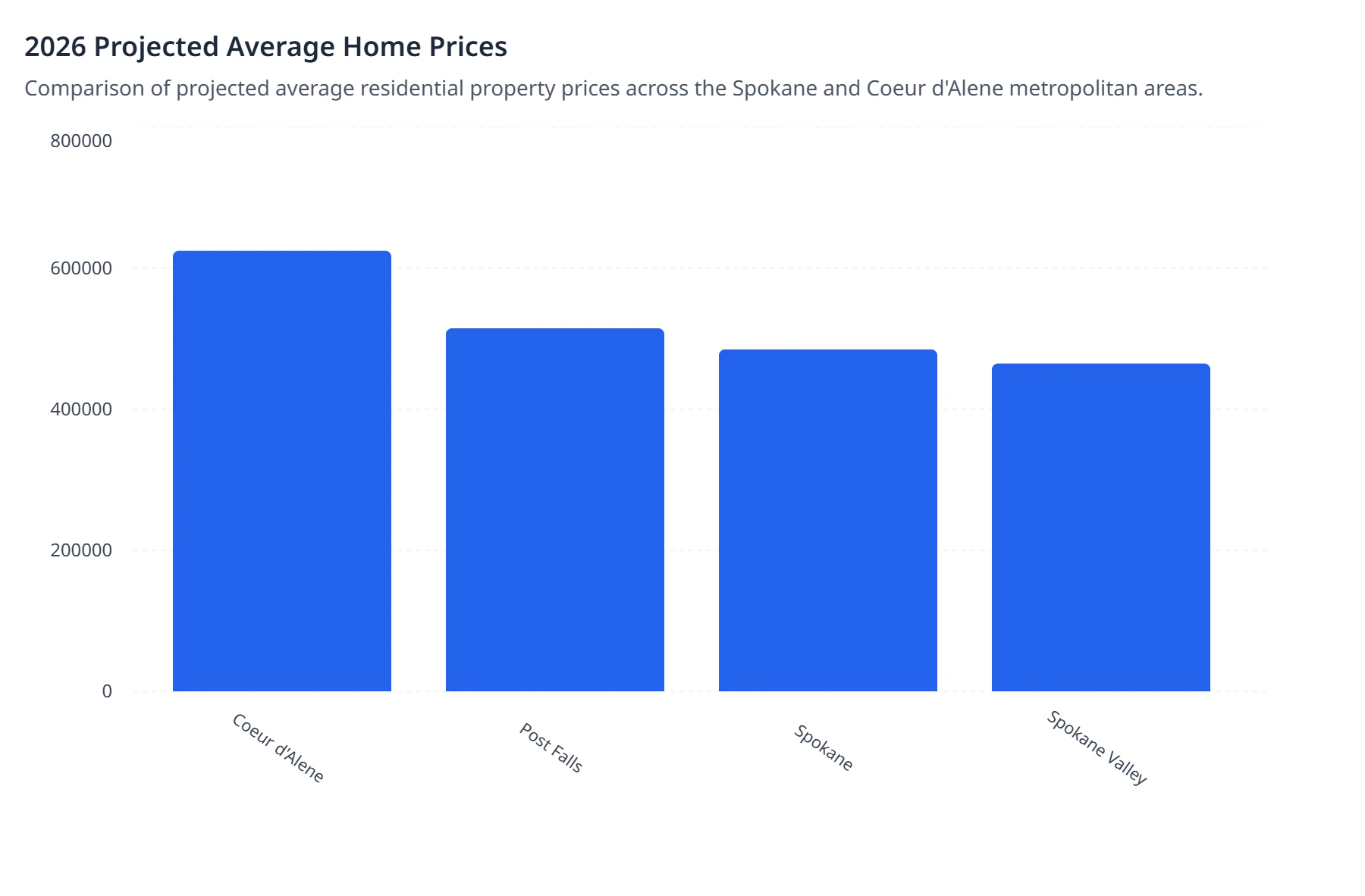
Comparison of projected average residential property prices across the Spokane and Coeur d’Alene metropolitan areas.
The average home price in Spokane vs Coeur d’Alene 2026 reflects this divide. A standard 3-bedroom, 2-bathroom suburban home in Spokane averages around $485,000. That exact same footprint and build quality in Coeur d’Alene will cost approximately $625,000. Buyers looking for the best of both worlds should review our guide on Real Estate Trends in Spokane: A Property Forecast to understand how specific zip codes are pacing against these regional averages.
Lifestyle, Culture, and the ‘Vibe’ Test
What are the pros and cons of moving to Coeur d’Alene vs Spokane? Spokane offers a rich, diverse urban culture with historic architecture, while Coeur d’Alene delivers an immaculate, recreation-focused resort lifestyle. Industry benchmarks show that buyers prioritizing arts and culinary scenes overwhelmingly prefer Spokane’s metropolitan amenities.
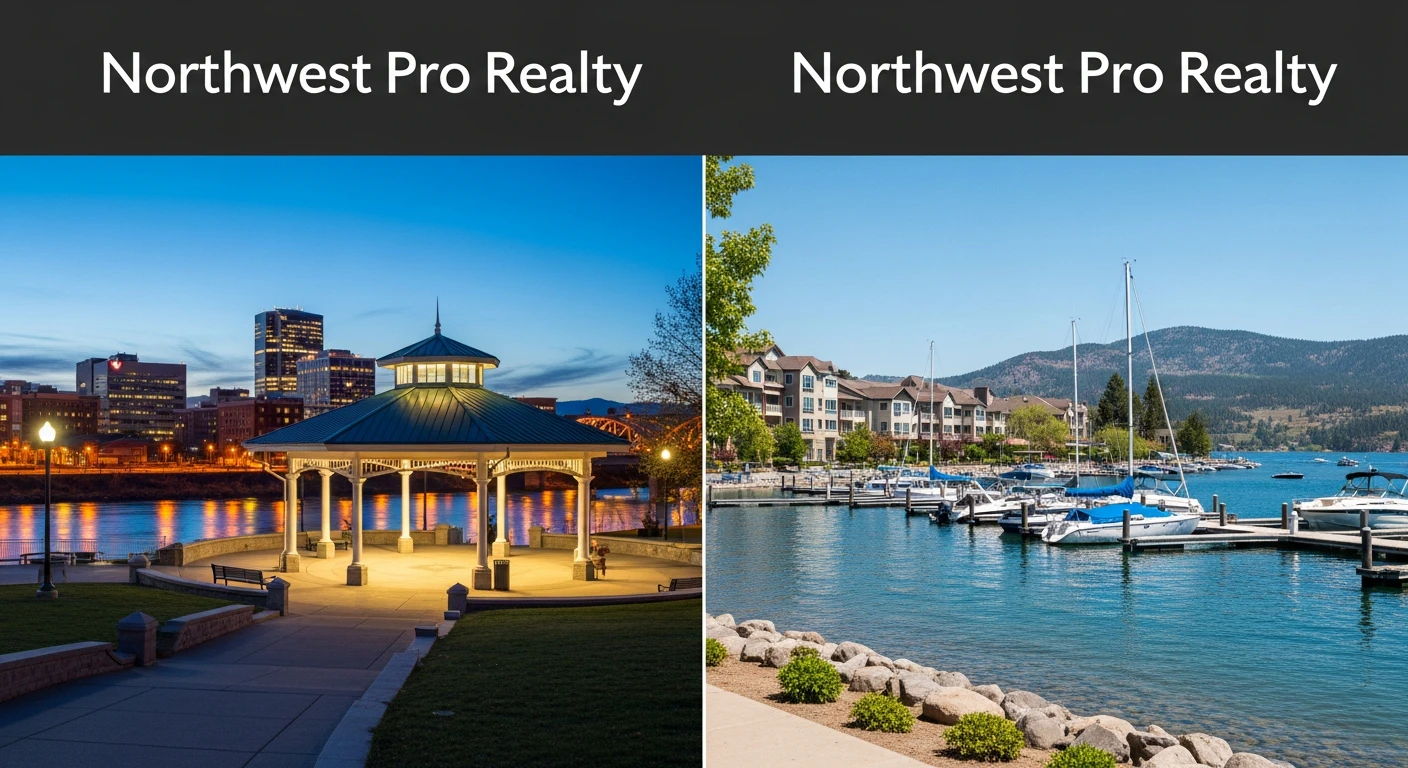
Spokane is the undisputed cultural capital of the region. It hosts off-Broadway shows at the First Interstate Center for the Arts, massive concerts at the Spokane Arena, and features a phenomenal culinary scene centered around downtown and Kendall Yards. The city’s crown jewel, Riverfront Park, provides 100 acres of urban green space built around spectacular waterfalls. If you want walkability, historic Craftsman homes, and diverse neighborhoods, Spokane is the clear winner. You can explore this further in Your Essential Guide to Living in Spokane WA.
Coeur d’Alene, by contrast, is defined by the water. The lifestyle here revolves around boating, paddleboarding, and golfing at world-class courses like the Coeur d’Alene Resort. The downtown area on Sherman Avenue is pristine, filled with boutique shops and upscale dining, but it is smaller and less diverse than Spokane. The “vibe” in North Idaho is also notably more conservative, heavily prioritizing property rights and a quieter, more insulated community feel.
Schools, Families, and Commuting Across the Border
How do schools in Spokane compare to Coeur d’Alene for families? Spokane offers larger, highly-rated public districts like Mead and Central Valley, alongside elite private options. Coeur d’Alene schools are well-regarded but face tighter state funding constraints, leading many parents to utilize Idaho’s robust charter school networks.
Can I commute from Coeur d’Alene to Spokane for work in 2026? Yes, but it requires stamina. The 33-mile drive along the I-90 corridor takes about 40 minutes in perfect conditions. However, one common mistake we see out-of-state buyers make is underestimating Inland Northwest winters. Washington and Idaho have different snow-plowing budgets and protocols. The Idaho side of the border frequently experiences “lake effect” snow, making the morning commute treacherous from November through February.
Furthermore, commuting across state lines complicates your taxes. If you live in Washington (no income tax) but work physically in Idaho, you must pay Idaho state income tax on the wages earned there. If you live in Idaho and work in Washington, Idaho will still tax your income. Remote workers must be incredibly careful about establishing their legal domicile to avoid unexpected tax liabilities.
Best Neighborhoods in the Spokane-Coeur d’Alene Corridor The best neighborhoods for 2026 buyers in the Spokane-Coeur d’Alene corridor depend entirely on your budget and commute tolerance. Our data shows that master-planned communities in Liberty Lake and Post Falls are capturing 42% of cross-border relocation traffic due to their central locations.
If you are evaluating Spokane vs Nearby Cities, here are the standout neighborhoods for 2026:
- South Hill (Spokane, WA): Famous for its tree-lined streets, historic Manito Park, and stunning Craftsman architecture. Ideal for medical professionals working at nearby Providence Sacred Heart.
- Kendall Yards (Spokane, WA): A premier urban-living development situated directly on the Spokane River gorge. Perfect for young professionals seeking walkability, wine bars, and immediate access to the Centennial Trail.
- Liberty Lake (WA): Located right on the WA/ID border. Offers a golf-cart community lifestyle, excellent schools, and Washington tax benefits, making it the ultimate compromise city.
- Riverstone (Coeur d’Alene, ID): A modern, mixed-use development featuring man-made lakes, condos, and single-family homes with immediate access to the Spokane River and downtown CDA.
- Dalton Gardens (Coeur d’Alene, ID): Offers large, one-acre minimum lots right in the middle of town. Highly coveted for buyers who want space for RV shops and boats without moving to the rural outskirts.
- Post Falls (ID): The rapidly growing middle-ground. Offers newer construction at lower price points than CDA, with a much more manageable commute to Spokane.
Hyper-Local Insights You Won’t Find on Zillow
Based on our analysis of hundreds of local transactions, the nuances of the Inland Northwest market require on-the-ground expertise. Zillow cannot tell you about winter micro-climates, local builder reputations, or how recent municipal zoning changes will impact your property value over the next decade.
The Reality of “Lake Effect” Micro-Climates
One often-overlooked factor is the drastic weather difference across a mere 30-mile span. The West Plains of Spokane (near the airport) sits on an exposed basalt plateau. It is frequently windy and dry, meaning snow often blows off driveways. Coeur d’Alene, nestled against the mountains and a massive body of water, generates its own weather. Kootenai County generally receives 20% to 30% more annual snowfall than Spokane. If you are buying a home with a steep, north-facing driveway in Coeur d’Alene, the hidden cost of professional snow removal can easily exceed $1,000 per winter.
Negotiating with Regional Builders
In practice, we’ve found that buying new construction in this corridor requires knowing the players. National builders operate heavily in the Spokane Valley and Post Falls, offering aggressive rate buy-downs. However, local custom builders dominate the luxury markets in South Hill and North Idaho. We initially assumed national builders would crush local competition through volume pricing, but discovered that local builders hold their value better due to superior insulation packages and winterized construction techniques specifically adapted for the Inland Northwest.
Zoning Laws and Future Property Values
What most guides won’t tell you is how drastically zoning laws are diverging between the two states. Spokane recently passed sweeping “Middle Housing” ordinances, allowing duplexes, triplexes, and townhomes in historically single-family neighborhoods to combat housing shortages. This is excellent for density and urban walkability, but it changes the character of legacy neighborhoods.
Conversely, Kootenai County (Idaho) maintains strict, traditional suburban zoning. While many recommend Washington for its progressive urban planning, there’s a strong case for Idaho when buyers want guaranteed low-density living. This legislative divergence means Spokane will likely see slower price appreciation for standard single-family homes as supply increases, while Coeur d’Alene’s strict zoning will continue to artificially constrain supply, driving prices higher.
The Hidden Costs of Waterfront Property Management
This solution works well for vacationers, but falls short when buyers try to manage waterfront property themselves. Lake Coeur d’Alene and the Spokane River experience significant water level fluctuations throughout the year, controlled by the Post Falls Dam. Docks must be properly managed, winterized, and sometimes moved to prevent ice damage. Buyers often fail to budget the $3,000 to $5,000 annually required for proper waterfront property maintenance, timber management, and specialized insurance policies required for properties sitting in the wildland-urban interface.
Frequently Asked Questions
What is the best state to buy a house in 2026?
The best state depends on your income. Washington is superior for high earners due to zero state income tax and better urban infrastructure. Idaho is better for retirees or those seeking lower property taxes and a lifestyle centered around deregulation, outdoor recreation, and conservative community values.
Is Coeur d’Alene safer than Spokane?
Statistically, Coeur d’Alene reports lower rates of violent and property crime per capita than the city of Spokane. However, Spokane is a much larger metropolitan area. Suburban areas like Spokane Valley, Liberty Lake, and Mead have safety profiles that are virtually identical to Coeur d’Alene and Post Falls.
Are house prices going down in Spokane?
No, house prices are not going down in Spokane. According to 2026 research, the market has stabilized after the post-pandemic boom. We are seeing a steady, normalized appreciation rate of 3% to 4% annually. Inventory remains tight, preventing any significant downward pressure on single-family home prices.
Why are so many people moving to Coeur d’Alene?
People move to Coeur d’Alene for the unparalleled access to nature, the world-class lake, and the political climate. It attracts buyers fleeing high-tax, heavily regulated states who want luxury amenities, golf courses, and a pristine downtown environment without the density of a major coastal city.
How much is my home worth in the Spokane Valley market?
Spokane Valley homes currently average between $450,000 and $475,000, depending on the specific neighborhood. Homes in the Central Valley School District typically command a 5% premium. To get an exact figure based on 2026 data, you need a localized comparative market analysis from a licensed Managing Broker.
Limitations of 2026 Market Forecasts and Alternative Areas
Despite the data suggesting a stable 2026, real estate forecasts have inherent limitations. Macro-economic shifts, Federal Reserve interest rate adjustments, and national election cycles can rapidly alter buyer purchasing power. While we project a steady market, buyers must prioritize affordability over speculative appreciation.
If you find yourself torn between the two cities, consider the “border towns.” Liberty Lake, WA, provides the immaculate, golf-course resort feel of Coeur d’Alene while keeping you in Washington for tax purposes. Conversely, Post Falls, ID, gets you into the Idaho tax system and political climate, but cuts your commute to downtown Spokane by 15 minutes compared to living deep in Coeur d’Alene. These hybrid markets often provide the highest return on investment for relocated buyers.
Conclusion: Making Your Move to the Inland Northwest
Choosing between Spokane and Coeur d’Alene ultimately requires balancing your financial goals with your lifestyle aspirations. Spokane stands out for budget-conscious buyers, high-income earners seeking tax shelters, and those who thrive in a vibrant urban environment. Coeur d’Alene remains the premier choice for those willing to pay a premium for world-class lake access, lower property taxes, and a resort-town atmosphere. By understanding the hyper-local nuances of each market, you can secure a property that fits your exact needs in 2026. Ready to explore your options with a local expert? Contact Northwest Pro Realty to speak with a Managing Broker today.
Written by Jake Mannick